Joe Wivoda, Chief Information Officer
Transforming any industry is challenging. Health care is going through a multidimensional transformation right now: Reimbursement changes from volume to value, increased focus on quality, and implementation of IT systems and meaningful use. Every hospital, clinic, skilled nursing facility, and indeed all health care providers are coping with these changes. Rural facilities share many of the same challenges as their urban counterparts, but there are some that are uniquely rural.
Providing patients with timely access to their health information, and getting sufficient numbers of them to view, download, or transmit their data, is a challenging meaningful use requirement. This is much less of a technological challenge, more of a marketing and patient engagement challenge. In a rural hospital or clinic, implementation of the patient portal can be challenging due to the lack of IT resources, and HIT vendors that focus on rural are often too busy to implement the portals early enough to build a patient engagement campaign. It takes time to engage patients and get them setup to log in to access their health information and it is important that rural providers engage their community as a whole. Discussing the benefits of online access to your health information on the radio and at public events will go a long way to get patients excited about being more involved in their care. Rural has a significant advantage here, primarily because they are so close to the community.
Participating in health information exchange, particularly state-based exchange, has been frustrating. Technological changes, unsustainable business models, and low adoption levels have kept state HIEs struggling. In addition, many HIEs have focused their efforts on capturing the urban hospitals and integrated delivery networks first, essentially putting rural on the back burner. Query-based HIE, as opposed to Direct Secure Messaging, is difficult to implement. Exchange is so important for Stage 2 of meaningful use, and for high quality and safe patient care, that it can not be ignored. Rural providers should look to Direct for being able to exchange with their referral partners while working with their local HIE for future query-based exchange.
Rural clinics and hospitals that do not have a culture of process improvement are at a significant disadvantage when implementing an EHR. All too often I visit rural facilities that have no established process improvement program. Based on my experience, this is the single most important thing to have when implementing an EHR. Without PI you will implement an EHR in a way that will likely decrease productivity, or worse, decrease patient safety. The EHR is not built with idealized processes "baked in", you need to do the work. Understand how you do things today, understand how the EHR works, design a new process. We like Lean as a methodology, but PDCA or others are valuable. Rural facilities, who are usually stretched for resources and have staff wearing many hats, need to make PI a core part of the culture. Urban hospitals and IDNs have been doing this for years, and CAHs that have embraced PI have been shown to be financially sound and their EHR implementations go much better with less fixing after the go live.
Rural has the ability to move quickly. These are challenges that can be overcome. Continuous process improvement, workflow analysis and redesign, should be central to not just the EHR implementation (or improvement) but to the operations as a whole. HIE, patient engagement, and improved utilization and efficiency from the EHR will follow once good process improvement activities are made central to the work.
What do you think are HIT implementation challenges in rural?

Tuesday, December 10, 2013

Thursday, November 21, 2013
National Rural Health Day: Reflections on the Past 30 Years in Rural Health and the Road Ahead
Terry Hill, Senior Advisor for Leadership and Policy
After being asked to compose a blog on the evolution of
health care over the thirty plus years of my career, I procrastinated until the
last minute. Looking backward has always
been a challenge for me, whether it's logging in technical assistance, filling
out travel vouchers for payment or just expounding on the good old days of
yesteryear. I always like to think about
what lies ahead. Perhaps the future
roads are growing shorter, but I'm just as excited as ever to explore what's
around the next curve or what's beyond the next great obstacle.
Using my road metaphor, there have been a lot of curvy
roads and a lot of formidable obstacles for rural health care in the past thirty
years. Difficulty recruiting and
retaining physicians and other primary care providers has been constant. Complexity has increased during this period
as thousands of new drugs have been launched, thousands of new medical
procedures have been used and thousands of new medical devices have been
approved. Technology expansion has been
another constant, as medical technology, telehealth technology and health information
technology have become commonplace in even our smallest most remote
facilities. The accelerating rate of
change in health care has been challenging for rural health providers, and at
times it has seemed that the next curve in the road would lead to a steep drop-off or at least an impassible road ahead. But somehow, we've always made it past the obstacles, thanks largely to
the determination, resiliency and innovation of our rural health providers and
their advocates. We do this work,
either directly or indirectly, because people living in small towns across
America depend on health care being available when it's needed. We do the work because it's an opportunity
to contribute and provide meaning to our professional lives.
The road ahead in 2013 and beyond is sure to be
especially bumpy, and maybe even hazardous for all health care providers. Dramatic transitions to a new payment system
based on value, with new requirements for better quality, better population
health and lower costs is already taking place. Rural health can not only survive in the ensuing era of health reform,
it can lead the way. I am optimistic
that new health care delivery models will be employed as effectively in rural
as in urban, and that new partnerships will be formed between rural and urban
health care organizations based on mutual value, rather than on strict referral
of patients. In short, rural will find a
meaningful place in the new health system.
The time for beginning the new road trip is now. Rural providers must start to plan their
future destination, and begin to equip themselves with the necessary
technology, quality processes and
efficiencies to be successful down the road. They should not pull off at the next rest stop to wait for further
instructions. The road to value does not
come with a GPS nor even a detailed roadmap. As has been done so many times in the past, we'll have to forge our way
past or through the obstacles, with limited resources and expertise, and arrive at a future system that is worth
celebrating. Better health, better
care, lower cost; I plan to be around to contribute at least in
some small way to that final destination.
Wednesday, November 20, 2013
National Rural Health Day 2013
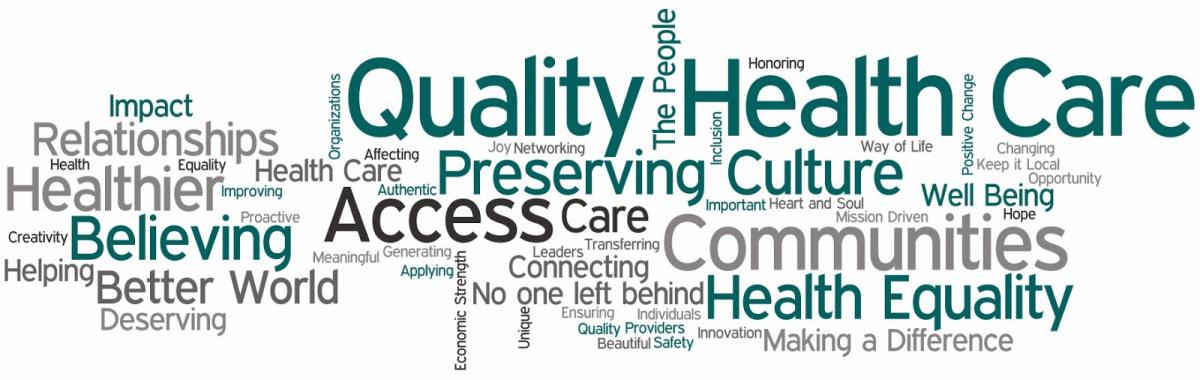
In celebration of National Rural Health Day 2013, staff members at National Rural Health Resource Center created this Wordle in response to the question "What does working with rural health mean to you?"
Tuesday, November 12, 2013
Community: What's in it for us?
Dennis Berens, Board Member, National Rural Health Resource Center
Community is one of those words in our language that is used
so often and in so many ways it may not have meaning for us today. So many
definitions, so much myth, so much emotion. What's in it for me and you? With
four generations alive and operating in our country today, I think this word
and its definition could serve as the missing link in our words and actions.
Think about your present definition of community and how many
"communities" you live in. I grew up on a farm that was a community.
I had ties to a very small town, and there were a number of communities there
for me. In the city where I live today, some of my neighbors help me create
community. Where else do we find community? Church? State? School? Work?
Those of you who know me have heard me say that community
exists among people who are willing to risk for each other. On a ten point
scale, you and I must be willing to risk at least at level one for us to be in community.
For me this definition hits one of the crucial elements in
humankind: TRUST. If we will not risk for someone, can we be in a trust
relationship? In today's world of instantaneous communication, whom do you
trust? And if you cannot trust, can you do business? Can you create meaningful
organizations and policies without trust? Can you have real and meaningful
relationships? Can you really have working communities?
Think about this word and your definition of it, and then
have a "community" discussion about what it means and how we can use
it to create a better world.
Contact the National Rural Health Resource Center to learn how to effectively engage your community in a meaningful conversation about the value of health.
Tuesday, October 1, 2013
CAH Blueprint for Performance Excellence
Kami Norland, Community Specialist
II

I have the privilege of traveling
across the country to visit critical access hospitals (CAHs) serving as the
Community Specialist for The Center. Through my adventures, I have observed how
CAHs face the challenges of being successful in the current payment system,
while preparing for the new value-based payment structure, all the while
striving to achieve the Triple Aim of,
“better care, better health, at a lower cost”. Managing the complexities
of these changes is not easy, so The Center assembled national rural hospital
experts in a Summit meeting this past June to begin the creations of a CAH
Blueprint for Performance Excellence modeled after Baldrige, which is a
comprehensive systems-based management framework.
This CAH Blueprint for PerformanceExcellence includes critical success factors in the seven Baldrige components and
outlines how each component is inter-linked:
Use of a systems-based performance
excellence framework, as such, provides CAHs with a formula for not only
achieving sustainability in this rapidly changing health care environment, but
it enables facilities to flourish when meaningful work is accomplished in each
of the seven components. As one Summit participant noted, “There is no cohesive
vision of what a future rural hospital needs to look like. We are in a perfect
storm. We can’t go back, but we can’t go forward by staying the same.” It is
important that CAH leaders begin to identify the key strategies necessary to
bridge the gap between where they are presently and where they will need to be
in a value-based health care system. The Blueprint can help do just that.
Challenges and strategies
faced by CAHs are also identified in this Blueprint, acknowledging that as a
rural hospital leader, you may feel daunted or overwhelmed in keeping up with
all of the ongoing changes, but do note that this Blueprint and The Center are
here to support your transition in achieving the Triple Aim.
Subscribe to:
Posts (Atom)